Is It Safe to Visit Bacalar? An Honest Assessment from Bacalar's Hospitality Sector
Boca de Agua is an award winning eco-luxury hideaway in Bacalar, Mexico, where our accommodations blend with the natural landscape.
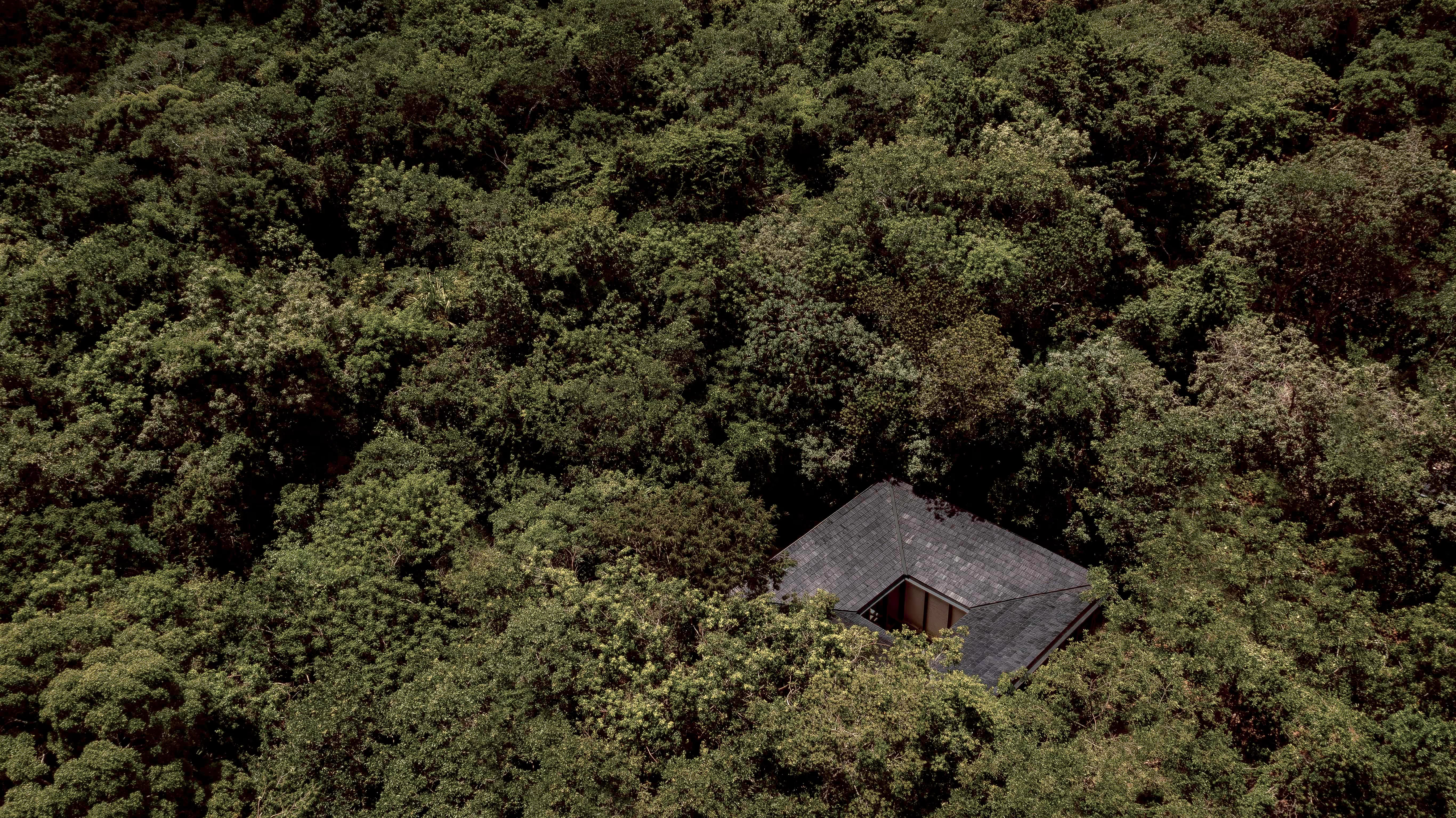





Boca de Aqua is an award winning eco-luxury hideaway in Bacalar, Mexico, where our accommodations blend with the natural landscape.
Discover moreBacalar's lagoon appears in every "hidden gems of Mexico" list, and for good reason. But between discovering this place and actually booking your trip, the safety question inevitably surfaces. Is this small town in southern Quintana Roo actually safe for international travelers?
Operating luxury accommodations in Bacalar has given us a particular perspective on this question. While many safety guides focus on general Mexico statistics or repeat the same generic advice, we see what happens day-to-day in this specific town.
This guide is based on operational experience—what we observe, what issues arise, and how they're resolved.
The Short Answer: What We Actually See Operating Here Daily
Based on daily coordination with local services and observing patterns across Bacalar's hospitality sector, we consistently see a low-incident environment for international visitors.
The operational pattern is straightforward: visitors arrive, experience Bacalar, and leave. The issues that arise are overwhelmingly logistical—not security-related. Most concerns we address involve the same minor friction points you'd encounter anywhere: a misunderstanding about taxi pricing, advice on which tours are worth the money, or helping someone navigate a lost credit card situation. These are hospitality challenges, not safety crises.
As of January 2026, the US State Department maintains Mexico at an overall Level 2 advisory ("Exercise Increased Caution")—the same level as France, Germany, and the United Kingdom. Within Mexico, risk profiles vary dramatically by state. Multiple states carry Level 3 ("Reconsider Travel") or Level 4 ("Do Not Travel") advisories, including Sinaloa, Zacatecas, Guerrero, Colima, Michoacán, and Tamaulipas, among others.
Quintana Roo—home to Bacalar, Cancún, Playa del Carmen, and Tulum—holds a Level 2 rating. The State Department's advisory notes that "criminal activity and violence may occur in any location, at any time" but doesn't identify Bacalar specifically as an area of elevated concern.
What matters more than any advisory level is understanding why Bacalar operates differently than the destinations generating those headlines. That context is what we spend the next several sections explaining.
Why Bacalar Functions Differently: An Insider's Perspective
The Hospitality Ecosystem Here Is Small-Scale
Bacalar has roughly 40,000 permanent residents—smaller than most American suburbs. The tourism infrastructure remains relatively limited compared to major destinations, which affects the security environment.
Because it's a small town, local business owners recognize each other. The community has a vested interest in protecting Bacalar's reputation because tourism is essential to its economic success.
Walk through Bacalar's town center on a Tuesday afternoon and you'll see locals going about regular life, not an endless stream of tour groups or spring breakers. The lagoon areas where most luxury accommodations sit are even quieter, with natural barriers like dense jungle or limited road access, therefore reducing traffic.
Compare this to Cancún's Hotel Zone, where hundreds of properties operate in relative isolation, guests cycle through by the thousands, and individual property managers have limited visibility into broader security patterns. That's not a criticism, but rather a different operational reality that comes with different risk exposure.
The Tourism Model Self-Selects for Lower-Risk Demographics
At Boca de Agua, as well as many of the surrounding properties, the typical guest profile includes couples in their 30s-50s, families with older children who appreciate nature experiences, solo travelers specifically seeking quieter environments, and retirees looking for authentic cultural immersion. These are, statistically speaking, lower-incident travelers. They're not getting drunk in town at 2 AM (because not much is open that late).
Bacalar's development pattern shaped who visits. The town never built mega-resorts or cruise terminals. There are no massive nightclub complexes. What developed instead were small-scale, design-focused properties—many with sustainability commitments—that cater to guests interested in architecture, ecology, and genuine cultural connection.
On the flip side, destinations built around high-volume, intoxication-heavy nightlife regularly face safety challenges: more opportunistic crime, more incidents requiring emergency services, more infrastructure strain. Bacalar's development path focused on, and therefore attracted, a more laid-back crowd.
Physical Geography Creates Natural Buffers
One reason we chose this location for Boca de Agua—and why many quality properties cluster along the lagoon's edges—is that the geography itself provides security advantages.
The water creates a natural barrier. Most properties are built within a dense jungle landscape. Road access to lagoon-side accommodations is limited and clearly defined—you can't just wander onto the property. Thoughtful site selection balances openness with appropriate boundaries.
Specifically, our elevated treehouse design maintains sightlines while preserving the jungle canopy. Staff can see who's on-site. Guests can see approaching pathways. It's passive security through architecture—far more effective than cameras and gates, and infinitely more pleasant to experience.
Thanks to Bacalar's location on the southern Yucatán Peninsula, near the Belize border and away from major trafficking routes, it's not a strategic point for organized crime activity that affects other regions. People come to Bacalar because they want to be in Bacalar—it's not a transit hub or crossroads.
Bacalar Safety Compared to Other Destinations
Understanding how Bacalar compares to other destinations—both within Mexico and internationally—helps contextualize what you'll actually experience.
Bacalar has around 40,000 residents with low-to-moderate tourism volume that's growing steadily. It's characterized as a small town with limited nightlife and nature-focused tourism. The typical concerns involve petty theft, transportation logistics, and limited medical infrastructure.
Tulum, with roughly 46,000 residents, handles significantly higher tourism volume despite being similar in size. Rapid development and an active nightlife scene have contributed to an organized crime presence widely reported in local media. More than 3,650 crimes were reported between January and August 2023 according to Observatorio Nacional Ciudadano analysis. Common issues include petty theft, violent incidents in nightlife areas, and taxi scams.
Playa del Carmen has grown to over 300,000 residents and processes very high tourism volume as a major resort destination with cruise terminals and extensive nightlife. Petty theft, tourist-targeted scams, and violent crime in nightlife zones are regularly reported in local media.
Cancún, the region's largest city with over 900,000 residents, handles very high tourism volume across mega-resorts, cruise terminals, and extensive tourist infrastructure. While petty theft and scams are common, cartel activity in suburbs is widely reported in local and national media—though this rarely affects resort zones directly.
For international comparison, Barcelona, Spain (population 1.6 million) manages very high tourism as a major European city and is frequently cited among Europe's highest for pickpocketing rates, with tourist-targeted theft being a persistent concern.
Bali's Ubud area in Indonesia, with around 75,000 residents, handles high tourism volume as a nature and culture destination. Common concerns include petty theft, scams, transportation safety issues, and traffic accidents.
Important notes on this comparison:
- Population figures are based on recent municipal census data and rounded for clarity
- Relative tourism volume represents directional assessment based on visible visitor infrastructure and accommodation capacity, not precise arrival statistics
- Security characteristics for Mexican destinations reflect patterns widely reported in local and national media, travel advisories, and civil-society organizations—these are observed patterns, not official comparative crime statistics
- Bacalar's data limitation: Unlike major cities, small municipalities like Bacalar lack publicly available, detailed crime statistics from authoritative sources like INEGI (Mexico's National Institute of Statistics and Geography)
Source: Observatorio Nacional Ciudadano analysis reporting more than 3,650 criminal incidents in Tulum from January to August 2023, widely cited in regional media coverage as evidence of Tulum topping Quintana Roo's crime statistics during that period
What this comparison reveals:
Bacalar's small scale fundamentally limits the volume of opportunistic crime compared to high-traffic destinations. Additionally, high-volume destinations generate more documented incidents simply due to scale and media attention, which doesn't necessarily mean proportionally higher risk for individual visitors.
Common Security Questions about Bacalar
"Should We Worry About Cartel Violence?"
Cartel-related violence is a real problem in specific parts of Mexico, and concerns about it are understandable.
The dynamics that drive cartel violence—territorial control over drug trafficking routes, competition for lucrative markets, enforcement of extortion schemes—don't center on Bacalar. The town is small, has limited nightlife with a minimal drug market, is distanced from major smuggling corridors, and lacks the high-value business infrastructure that attracts extortion activity.
Geographic context matters. Someone asking "Is Italy safe?" might have concerns about organized crime in a region like Naples, but that doesn't prevent millions from visiting Tuscany, Rome, or the Amalfi Coast. Similarly, understanding where Bacalar sits within Mexico's broader security landscape helps put risk in proper perspective.
"What Actually Goes Wrong? What Do You Deal With?"
This question gets to the heart of realistic expectations.
Petty theft does occur in Bacalar as it might in any tourist town, though comprehensive statistics are not publicly available. From visitor reports and hospitality sector observations, common issues include:
- Opportunistic theft from unsecured items at public areas—phones left unattended, bags left on docks, valuables in unlocked vehicles
- Overpricing by some taxi drivers or tour operators when prices aren't agreed upon beforehand
- Service quality issues with tours or activities that don't meet expectations
The more common issues we handle:
- Taxi fare misunderstandings: Guests didn't clarify the price before departing and were charged more than standard rates. At Boca de Agua, we provide rate guidance and help resolve disputes.
- Tour operator quality problems: A guide who didn't show up, a boat tour that wasn't as described. Our concierge staff assists in mediation and steering guests to reliable operators.
- Lost/forgotten items: Phone chargers, sunscreen, credit cards. Normal hospitality issues, not security concerns.
When minor issues arise, accommodations with professional management and local relationships are typically able to assist with resolution. This is one reason why choosing your accommodation thoughtfully matters significantly.
What we don't observe: Aggressive harassment of guests, violent crime targeting visitors, break-ins at properties with basic security measures, or systematic targeting of tourists.
"Is the Drive From Cancún/Tulum Safe?"
As many guests plan to arrive by car or private transfer, we commonly hear questions about driving on Highway 307.
Practical guidance for the drive:
The highway itself is well-maintained federal infrastructure with regular traffic flow. The primary concerns are logistics and driving conditions rather than security threats like highway robbery or cartel checkpoints.
What matters most:
- Fatigue: 3-4 hours of driving after an international flight. We strongly recommend driving while well-rested or arranging private transfer.
- Topes (speed bumps): They appear suddenly in towns along the route. Hitting one at highway speed damages vehicles and causes accidents.
- Livestock and wildlife: Particularly at dawn/dusk. Large animals on the highway are a documented hazard.
- Lack of services: Long stretches without gas stations or services. Leave with a full tank.
- Variable driver behavior: Mexican highway driving norms differ from US/Canada/Europe. Be defensive.
Our recommendation: Drive during daylight (ideally arriving before 6 PM). If your flight lands after 3 PM, consider spending a night in Tulum and driving to Bacalar the next morning. Or arrange private transfer—we can help coordinate this for you.
Many guests choose transfer services to avoid navigating Mexican highway driving after a long travel day.
What Different Types of Travelers to Bacalar Should Consider
Your safety priorities depend heavily on how you travel and what makes you comfortable. Here's what we've learned from hosting different guest profiles.
Solo Travelers (Especially Women): What Our Guests Report
We host solo travelers regularly. The feedback is remarkably consistent: Bacalar feels comfortable for independent travel.
What creates that comfort:
The town's small scale allows for rapid orientation. One walk through the center is enough to understand the layout—there's no overwhelming urban anonymity where you feel invisible or exposed.
Because Bacalar's demographic skews older and family-oriented, visitors won't need to navigate a spring break crowd or an aggressive party culture. The atmosphere is relaxed, almost sleepy—which many solo travelers specifically seek.
Most restaurants and accommodations close by 10 PM because there's simply no demand for late-night activity. This enhances safety perceptions: the absence of a late-night bar scene means fewer unpredictable situations.
A recent guest's perspective: Ale F. wrote on TripAdvisor: "As a solo traveler, I felt completely safe and supported throughout my stay, which allowed me to fully unwind and enjoy the magic of the place."
What we recommend: Choose accommodations with responsive management and good communication. Have a charged phone. Share your itinerary with someone back home. These are basic solo travel practices anywhere—not specific to Bacalar.
Families: What We See When Kids Are Visiting
Families with children appreciate Bacalar for reasons that overlap significantly with safety. The natural environment, calm lagoon water, and relative absence of aggressive commercialization create low-stress experiences.
Realistic family safety considerations:
Water safety: The lagoon near town center can get busy with boats and kayakers. Properties with private lagoon access or pools offer controlled environments where you can supervise children closely. Life jackets are essential for kids on boat tours or kayaking.
Sun and heat management: This is the most common "incident" families face—kids getting too much sun or not drinking enough water. The tropical climate is intense. Proper sun protection and constant hydration are essential.
Medical access: Bacalar has a basic clinic suitable for minor issues (scrapes, upset stomach, minor infections). Anything serious requires transport to Chetumal (40 minutes) or Cancún (3.5 hours). We help coordinate medical care when needed and strongly recommend comprehensive travel insurance for families.
Food safety: Our property and established restaurants in town serve purified water and maintain proper food safety. We guide families toward reliable options and away from street food if anyone has a sensitive stomach.
The most significant challenge families typically face in Bacalar is the absence of structured kids' entertainment—there's no arcade or kids' club. Which, depending on your travel philosophy, might be exactly what you're looking for.
Couples: What Matters For Romance and Privacy
Bacalar is exceptionally popular with couples seeking romantic escapes, as the intimate scale and quiet atmosphere work heavily in their favor.
Most couples dine at their accommodation—Flora can even arrange a romantic dinner for two under the stars—or make easy trips into town (10 minutes from Boca de Agua). The pace is slow, the energy relaxed. Evening walks along the lagoon feel safe because you'll typically see other couples, families, or local residents doing the same thing.
Ensuring your chosen property delivers the peaceful, private experience you're expecting matters more than any security consideration. Poor property management—unclear communication, inadequate maintenance, loud neighbors—ruins romance far more effectively than any safety concern you'll find here.
Boca de Agua's elevated treehouses provide privacy through separation, jungle surroundings create natural buffers, and our small scale means you're never dealing with resort crowds or noise.
Mature Travelers: Infrastructure and Accessibility Realities
We host many guests over 50 and 60 who are specifically seeking Bacalar's slower pace and authentic character.
Honest considerations for mature travelers:
Medical infrastructure: This is the primary concern for older guests. Serious medical issues require travel to Chetumal or Cancún. If you have significant health concerns, ensure your travel insurance covers medical evacuation and that you're comfortable with limited on-site resources.
Physical accessibility: Bacalar town has uneven sidewalks, limited ramps, and informal infrastructure. Our property has stairs and natural terrain that may challenge mobility. We're always honest about accessibility during booking—some properties work well for limited mobility, others don't.
Communication: English is spoken at tourism-focused businesses but less so in town. Having translation capability (phone app) or staying where staff can assist makes everything easier.
What works in mature travelers' favor: Bacalar's demographic and pace. It's a destination that respects quiet, relaxation, and slower rhythms that match the mood of many mature travelers.
How Property Choice Dramatically Affects Your Experience
Where you stay in Bacalar affects your sense of security and overall experience.
Location Creates Completely Different Experiences
Lagoon-side accommodations (like ours): Natural seclusion by design. Limited road access, jungle buffering, private lagoon frontage eliminate exposure to casual foot traffic or street activity. These properties typically cater to guests seeking privacy and tranquility.
In-town accommodations: Direct engagement with local life. More exposure to vendors, street dynamics, everyday community activity. Many travelers love this immersion, but it's not for everyone and should be carefully considered.
Remote or boat-access properties: Maximum privacy, potential isolation. Some guests love feeling completely removed; others find it uncomfortable. Think about your relationship with remote settings and whether you prefer to remain on site versus exploring town.
Professional Management Prevents Most "Safety" Concerns
Many safety concerns stem from operational issues rather than actual security threats.
When your room lock sticks and you can't secure your space... when paths aren't lit at night and you're navigating unfamiliar terrain in darkness... when there's no clear communication about who should be on the property... when you have a problem and don't know who to contact—these service failures create anxiety that guests label as "safety concerns."
Professional management provides:
- Clear communication in English (or your language)
- Working security measures (functioning locks, well-lit paths, clear boundaries)
- Responsive problem-solving when issues arise
- Local knowledge about reliable services, fair pricing, trustworthy operators
- Visible presence so you know staff is available if needed
These operational fundamentals prevent the friction points that make travelers feel unsafe.
Our specific approach: We provide every guest with detailed arrival instructions, 24-hour contact information, a property map with marked paths and lighting, emergency protocols, guidance on fair pricing for local services, and check-ins during your first days to ensure everything feels comfortable.
Budget accommodations may offer less comprehensive support, which works well for independent travelers but can add stress for those preferring more guidance in unfamiliar environments.
Private Lagoon Access: A Concrete Safety Advantage
Boca de Agua's private lagoon access with dedicated jetty provides several security advantages.
The private lagoon space is shared exclusively with registered guests and staff, creating a naturally secure environment without random foot traffic, vendors, or crowds. This monitored space allows you to relax completely without worrying about your belongings.
Enjoy full control over your daily experience. Visit public lagoon areas or head into town for more activity, then return to the calmer, private environment at Boca de Agua when you're ready to decompress. Many solo travelers and families specifically cite this balance as what makes them feel most comfortable.
What Guests Actually Report After Visiting
Verified TripAdvisor reviews for Boca de Agua reveal what visitors actually experience. Security concerns are notably absent from feedback. Instead, guests consistently describe the setting using words like "peaceful," "serene tranquility," "quiet," and "total relaxation."
One guest wrote: "This place is perfect to disconnect from the city and connect 100% with nature." Another noted: "A place of silence and peace, total relaxation hidden in the jungle."
The overwhelmingly positive reviews focus on design quality ("Architecture in nature," "exceptional and exclusive"), service responsiveness ("the staff is very caring," "they attend to you very well in every detail"), and the lagoon experience ("The lagoon is magical, healing").
When operational issues do appear in reviews across Bacalar properties generally, they involve typical hospitality matters—restaurant service timing, WiFi consistency, maintenance needs—not safety concerns. What guests consistently report is feeling comfortable and secure in Bacalar's tranquil environment.
The Realistic Risks: What Can Actually Go Wrong
Understanding what issues commonly arise helps set appropriate expectations.
Minor opportunistic theft: Phones left on docks, wallets in unlocked cars, bags left unattended. It happens. Use basic precautions.
Transportation hassles: Flat tires, GPS failures, taxis that don't show up. These are logistical headaches, not dangers, but they're more likely than crime.
Medical situations requiring transport: In a small, remote town, serious medical care requires travel. This is a function of location, not safety.
Environmental factors: Sunburn, dehydration, insect bites, heat exhaustion. Bacalar is tropical jungle. Come prepared.
Cultural misunderstandings: Different service pacing, communication gaps, varying business practices. These aren't safety problems but can feel uncomfortable.
Practical Safety Guidance From Daily Operations
Based on operational experience in Bacalar:
Money: Carry small bills (many places can't break 500-peso notes). Use ATMs inside banks or businesses during daylight. Cards work most places now, but cash smooths everything.
Valuables: Use accommodation safes. Don't wear expensive jewelry in town. Visible wealth creates opportunity anywhere.
Communication: Charged phone with service. Downloaded offline maps. Someone back home knows your itinerary.
Transportation: Agree on taxi prices before starting. Book tours through your accommodation when possible. Drive during daylight if you're driving yourself.
Cultural respect: Bacalar is a real community. Dress appropriately in town, respect quiet hours, ask permission before photographing people or private property.
Sun and water: The most common problem visitors face. Aggressive sun protection, constant hydration, respect for heat.
Emergency contacts:
- Emergency number: 911
- US Embassy in Mexico: +52 (55) 5080-2000
- Your accommodation's emergency contact (request this at check-in)
When to Visit: Logistics Vary More Than Safety
Safety doesn't change dramatically by season in Bacalar, but operational conditions do:
Dry season (November-April): Peak season. Better road conditions, more reliable weather, more services operating consistently.
Rainy season (May-October): Fewer visitors, lower prices, occasional heavy rain affecting roads. Hurricane season (August-October) brings weather risk, though Bacalar rarely faces direct hits.
Major holidays: Mexican holidays bring domestic tourists, changing the atmosphere but not safety considerations.
Consider your comfort with variable conditions. Peak season offers predictability; off-season offers authenticity and requires more adaptability.
The Real Question: Are You Right For Bacalar?
Is Bacalar risk-free? No. Can you visit safely and have an exceptional experience? Based on available evidence and operational observations—absolutely. Thousands do annually without incident.
Bacalar works exceptionally well for guests who:
- Value natural beauty and authentic experiences over resort infrastructure
- Prefer smaller-scale, design-focused accommodations
- Are comfortable with remoteness and limited services
- Want Mexico beyond the mega-resort zones
- Can navigate Spanish-language environments patiently
- Prioritize relaxation and nature over nightlife and activities
Reconsider if:
- You need extensive medical infrastructure nearby
- You're uncomfortable with any infrastructure informality
- You want completely controlled, predictable environments
- You're only comfortable in major cities with extensive English support
The real question isn't "Is Bacalar dangerous?" It's "Are you the kind of traveler who'll thrive in what Bacalar offers?" If you are, the available evidence suggests safety concerns shouldn't hold you back.
Ready to experience Bacalar with confidence? Explore our carefully curated collection of luxury treehouses and eco-conscious packages designed for guests who value both sophisticated comfort and authentic connection to this remarkable place.
For peace of mind before you go, download our comprehensive Bacalar Safety & Travel Checklist. This practical resource includes:
- Pre-departure preparation checklist (documentation, insurance, health precautions)
- Packing essentials specific to Bacalar's environment
- On-the-ground safety practices by activity type
- Emergency contact information and protocols
- Local service provider recommendations (vetted by our team)
- Spanish phrases for common situations
- Transportation safety guidelines
- What to do if something goes wrong