16 Best Things to Do in Bacalar, Mexico: The Complete Travel Guide
Boca de Agua is an award winning eco-luxury hideaway in Bacalar, Mexico, where our accommodations blend with the natural landscape.





Boca de Aqua is an award winning eco-luxury hideaway in Bacalar, Mexico, where our accommodations blend with the natural landscape.
Discover moreMost people arrive in Bacalar having seen a photo of the lagoon of seven colors. Few are prepared for what it actually feels like to be on it.
Bacalar is a Pueblo Mágico town in southern Quintana Roo built around a 42-kilometer freshwater lake, seven distinct shades of blue over a white limestone bed, filtered by stromatolites that have existed since Earth's earliest life forms.
You kayak over them at sunrise. You drift through the Pirates' Channel, where the water drops to dozens of meters and turns a blue that has no good name for it. You swim in open-air cenotes, walk streets lined with street art and hammock workshops, and eat fish pulled from the same water you swam in that morning.
This guide covers what's worth your time in Bacalar, on the water, in the cenotes, through the town, and into the surrounding jungle.
Why Bacalar Deserves Your Attention
The Lagoon of Seven Colors isn’t a marketing invention. Depths ranging from shallow limestone flats to drops of more than 90 meters create genuinely distinct bands of color: pale turquoise where the bottom sits close to the surface, deep sapphire where it falls away. Exceptional water clarity allows visibility of more than 20 meters in some areas.
The shades of blue shift throughout the day, from soft pastels at dawn to vivid blues at midday and teal tones by late afternoon. It’s one of the reasons Bacalar rewards a longer stay: the lagoon you see at 6 AM is not the same lagoon you see at 5 PM.
What makes it scientifically significant — beyond its beauty — are the stromatolites: living microbial communities similar to Earth’s earliest life forms from 3.5 billion years ago. Bacalar is home to one of fewer than ten comparable sites worldwide. They can be seen from kayaks throughout the southern lagoon, quietly filtering water as they have for millennia.
Bacalar vs. Other Quintana Roo Destinations
Bacalar is unlike the rest of Quintana Roo. There are no Caribbean beaches, mega-resorts, or international nightlife scene. Instead, you’ll find a 42-kilometer freshwater lagoon, open-air cenotes connected to underground rivers, a Pueblo Mágico with real community life, and an emerging architecture scene shaped in part by Frida Escobedo. Travelers expecting Tulum leave confused. Travelers expecting Bacalar usually extend their stay.
Best time to visit: November through April for dry weather. Shoulder months (November and April–May) offer fewer crowds and better rates. June through October brings afternoon rain and high humidity, but also the fewest tourists and most availability.
Best Things to Do in Bacalar Beyond the Lagoon's Seven Colors
Bacalar centers on its lagoon, but the lagoon alone isn't enough to explain why people extend their stays, cancel their next destination, or come back the following year. What keeps them is the combination: swimming above living stromatolites in crystal-clear freshwater at dawn, open-air cenotes connected to underground rivers, a town center that moves at its own pace, and jungle architecture designed to leave more intact than it found.
These are the best things to do in Bacalar, organized by category and time of day.
On the Water: Experiencing Bacalar's Lagoon
1. Sunrise Kayaking
Launch before 6:30 AM and the lagoon belongs to you. The water is glass-still before other boats start their motors, and the colors shift from dark to pastel to vivid as the sun rises through the trees. This is the experience most visitors describe when they try to explain what Bacalar actually feels like.
Properties with private lagoon access offer the most peaceful starting points. Public access points near Bacalar town work as well, though you'll share the water with fishing boats earlier than expected.
What to bring: Reef-safe sunscreen only — chemical formulas harm the lagoon's ecosystem. Water and a waterproof phone case.
🟡 Pro tip: Boca de Agua guests have private lagoon access and can launch directly from the property dock before any other boats are on the water.
2. Sailing Tours Through Stromatolite Fields
Skip the 20-person pontoon boats. A private or small-group sailboat is quiet enough to hear your captain explain what's below the surface. Good operators anchor away from stromatolite beds, use sail whenever possible, and cap group size to protect sensitive areas.
What a good sailing tour looks like: No music. No contact with stromatolites. Captains who position the boat for viewing without disturbing the formations. Guides who know Bird Island's nesting seasons and maintain distance accordingly.
Cost: Approximately 1,200–2,500 pesos ($60–125 USD) for a half-day private or semi-private boat trip.
Choosing Sustainable Boat Tours
In recent years, certain parts of the lagoon have felt the strain of overtourism, especially from high-volume boat tours.
Operators we recommend:
- Sailing Colibrí Bacalar Tours - private small‑group sailing, focus on quality and local products, positive environmental impact.
- Adventure Lab Bacalar - nature‑oriented lagoon tours, low‑noise, eco‑minded experiences.
- Bacalove Sailing - small‑boat sailing tours, relaxed scenic outings on the lagoon
🟡 What to avoid: Be cautious with very cheap tours; some keep prices low by packing boats, using older motors, or skipping basic conservation practices. Look for operators that cap group size, follow no-music/no-contact-with-stromatolites rules, and use cleaner boats, even if they cost a bit more.
3. Los Rápidos: Bacalar's Natural Lazy River
Los Rápidos is a natural current where the lagoon narrows between two sections, creating a gentle drift that swimmers float through on life rings. It's one of the more unusual and genuinely fun things to do in Bacalar — low-effort, high-reward, accessible to anyone who can swim.
The current runs year-round and is strongest after rainy season. Local vendors rent life rings nearby. No entrance fee for the water itself, though the surrounding balneario may charge for facilities.
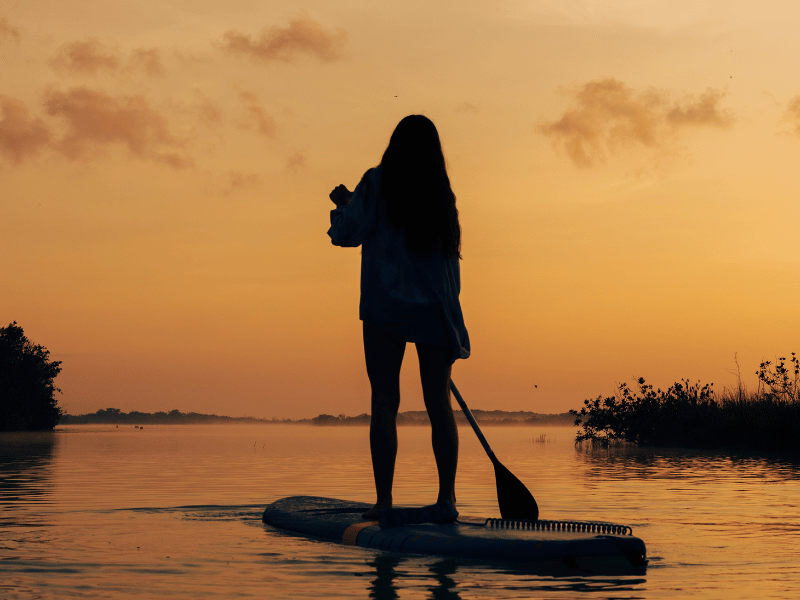
4. Stand-Up Paddleboarding Through Mangroves
The lagoon's eastern mangrove channels offer intimate passages where roots form natural archways and small fish move beneath your board. Herons, egrets, and cormorants are common. Small crocodiles sun themselves on banks and slip into the water as you approach.
Go before 10 AM. Heat and wind intensify quickly after that, and the channels lose their stillness. Mangrove systems filter the lagoon and prevent erosion — paddling through them slowly is one of the better ways to understand what makes Bacalar's ecosystem function.
5. Pirates' Channel (Canal de los Piratas)
The Pirates' Channel connects the lagoon to the Caribbean via a narrow waterway documented in 17th-century Spanish colonial records as a raiding route into the interior. Today it's one of the lagoon's deepest sections — creating the most intense blue coloration anywhere in the freshwater system.
Access by kayak or boat tour. The current can be stronger than it looks; stay near shallow areas if you're not a confident open-water swimmer. Year-round water temperature averages 26°C (78°F).
6. Beach Clubs on the Lagoon
Several beach clubs line the lagoon road south of Bacalar town, offering dock access, hammocks strung over the water, food, and drinks. This is the more social, laid-back version of the lagoon experience — less athletic than kayaking, more about floating and watching the shades of blue change through the afternoon. Look for smaller, locally run spots over large commercial operations.
Cenotes and Natural Wonders Near Bacalar
7. Cenote Azul: The Classic
Cenote Azul sits just outside Bacalar town — a massive, open-air cenote with water reaching 90-meter depths. The blue color comes from mineral content and light refraction through limestone. It's the most visited cenote in the area, which means timing matters: go on weekday mornings or late afternoons.
Facilities: Restaurant, changing rooms, life jackets (required in deep sections), cliff jumping platforms.
Entrance fee: Approximately 50–100 pesos ($3–6 USD).
Unlike cave cenotes found elsewhere on the Yucatán Peninsula, Cenote Azul is completely open to sky. Water stays cooler than the lagoon — around 23–24°C — which feels noticeably refreshing in Bacalar's humidity.
8. Cenote Cocalitos: Living Stromatolites Up Close
Cenote Cocalitos connects to the southern lagoon and is worth visiting specifically for stromatolites. These shallow, textured formations are visible from the water's edge. You can swim near them — but touching damages structures that took millennia to form.
Conservation guidelines:
- Reef-safe sunscreen only
- No standing on or touching stromatolites
- No flotation devices that could drag or bump the formations
Entrance fee: Approximately 50–100 pesos ($3–6 USD). The stromatolites photograph well in late afternoon light.
🟡 Conservation guidelines:
- Reef-safe sunscreen only (chemical sunscreens harm the microbial communities)
- Don't stand on or touch stromatolites
- No flotation devices that might drag or bump
9. Cenote Negro and Hidden Cenotes
Several lesser-known cenotes sit between Bacalar and Chetumal — Cenote Negro, Cenote Esmeralda, and others that don't appear on major travel maps. They require transportation and sometimes a walk on unmarked paths. Entrance fees go directly to local families who maintain access.
Some cenotes sit on ejido (communal) land or are considered sacred by local Maya communities. If signage restricts access or local people discourage entry, respect those boundaries.
Cultural and Historical Experiences
10. Fuerte de San Felipe
This 18th-century Spanish fort overlooks the lagoon from Bacalar's highest point — built to defend against the same pirates whose channel you kayak through. It now houses a small museum covering Bacalar's history from Maya settlement through the Caste War to the present.
Visit details: Open Tuesday–Sunday, 9 AM–5 PM. Entrance fee approximately 75 pesos ($4 USD). Plan 45–60 minutes. The ramparts offer the best aerial overview of the lagoon's color gradients — worth seeing at least once from above rather than from water level.
11. Bacalar Town Center
Bacalar's Pueblo Mágico designation recognizes its preserved lagoonfront, colorful streets, and living Maya-influenced culture. The streets radiating from the main plaza hold local shops selling handwoven hammocks and carved wood, small markets where residents shop for produce, street art incorporating Maya iconography, and taquerías that fill with families after 2 PM.
English is limited outside hotels and major tour operators. Basic Spanish goes further here than anywhere on the Riviera Maya. The town operates on its own rhythm — shops close for afternoon siestas, life happens at its own pace — and that rhythm is not an inconvenience. It's the point.
12. Maya Heritage: Present, Not Past
Bacalar's name comes from Maya language. Bak Halal roughly translates to "surrounded by reeds." Archaeological evidence documents continuous occupation here for over 2,000 years. Many Bacalar residents have Maya heritage; some speak Maya languages at home.
Seek community-run initiatives over performative ceremonies. Several local cooperatives offer cooking classes, craft workshops, and cultural exchanges where proceeds stay in the community. Ask permission before photographing people. Don't refer to Maya culture in past tense — it's present.
🔵 Internal link: Traveling respectfully in Bacalar → [link]
13. Mayan Ruins Near Bacalar
Kohunlich (65 km west) features the Temple of Masks with large stucco faces. Dzibanché (80 km west) has pyramids you can still climb, with a fraction of the visitors you'd find at Tulum or Chichen Itzá. Both require a car and about an hour's drive. Bring water and insect repellent — shade is minimal.
Culinary Adventures in Bacalar
What to Eat in Bacalar
Seek out:
- Fresh fish: robalo (snook), mojarra, and bass prepared a la plancha, al mojo de ajo, or tikin xic (achiote-marinated and grilled in banana leaves)
- Yucatecan specialties: cochinita pibil, panuchos, salbutes
- Local produce: chaya, xcatic peppers, epazote, chicozapote, mamey
- Tacos from market-adjacent spots in the town center
Mr. Taco is a local institution. La Playita is a waterfront palapa reliable for fresh catches and dock views. Waah Cocina de Origen serves traditional Yucatecan cooking without pretense. La Cabanita Grill & Cantina is a women-run fonda with generous portions.
Flora at Boca de Agua
Flora works with seasonal Yucatecan ingredients interpreted through contemporary technique. Chef Carlos Bordonave's menu changes based on what local producers bring each week — direct relationships with nearby farms and fishermen rather than wholesale supply chains. The setting is open to the jungle and lagoon.
🟡Flora at Boca de Agua is one of the few restaurants in the region where the kitchen's sourcing decisions are as considered as its cooking. Worth booking in advance.
Explore Flora's approach to Yucatecan cuisine.
Other recommendations:
- La Cabanita Grill & Cantina - casual, women-run fonda with generous portions
- La Playita - waterfront palapa, fresh catches
- Waah Cocina de Origen - traditional Yucatecan cocina
Places with picture menus in four languages often signal tourist-focused spots with less attention to quality.
Regional Drinks
More interesting than mezcal (which isn't cultivated in Yucatán) is xtabentún — a regional liqueur made from fermented honey and anise, produced on the Yucatán Peninsula for centuries. Craft cocktails incorporating chaya, hibiscus, and tropical fruit appear on menus throughout Bacalar.
Cooking Classes
Several operators offer market tours followed by hands-on cooking. Cocina Micelio is consistently recommended. These classes run 3–4 hours and cost approximately 800–1,500 pesos ($40–75 USD). Choose classes run by local families — your pesos stay in the community.
Recommended: Cocina Micelio
Wellness and Slow Travel
14. Yoga and Outdoor Practice
Several studios in Bacalar offer classes on platforms overlooking the lagoon, in jungle clearings, or on rooftops. Drop-in classes cost 150–300 pesos ($8–15 USD). Some properties offer complimentary sessions for guests — ask the team at Boca de Agua for current scheduling.
The setting does a lot of the work. Practicing on a platform over the lagoon at 6:30 AM, with the water still and the birds beginning, is a different experience from a studio class. The context is the practice.
15. Spa Treatments in the Jungle
Several properties offer massage and spa services in open settings — treatment rooms with walls open to jungle, platforms overlooking the lagoon. A 90-minute massage typically costs 1,200–2,000 pesos ($60–100 USD). Quality varies; ask your hotel for specific recommendations or read recent reviews.
Some spas incorporate Maya-influenced approaches — temazcal (sweat lodge) ceremonies, herbal compresses, copal smoke. Ask who conducts ceremonies and what their background involves. Legitimate temazcal leaders train for years and approach the practice as sacred, not aesthetic.
16. The Art of Doing Nothing
Hammock culture is not a cliché in Bacalar — it's the appropriate response to the afternoon heat and the pace of the place. Dock hammocks, hammocks strung between trees over the water, palapa hammocks facing the lagoon. The ritual is: launch the kayak at dawn, eat well at midday, find a hammock by 2 PM, return to the water by 5.
Spotty Wi-Fi and slow cell data outside town help this rhythm along. After two or three days, that stops feeling like a limitation.
🟡 Slow travel note: The travelers who get the most out of Bacalar are the ones who stop trying to fill it. Build your days loosely. Leave room for the lagoon to change color twice.
Best Time of Day for Activities in Bacalar
- Dawn (5:30–7:00 AM): Kayak or paddleboard before other boats launch. The lagoon is yours.
- Morning (7:00–11:00 AM): Breakfast, a cenote visit, a boat tour. The light is good and the heat is manageable.
- Midday (12:00–4:00 PM): Retreat from the sun. Read in a hammock. Swim when you feel like it. Nap. The midday hours in Bacalar are not wasted — they're the rhythm of the place.
- Late afternoon (4:00–6:00 PM): Bike into town for the market. Visit a cenote as crowds thin. The light softens and temperatures drop.
- Sunset (6:30–7:30 PM): Find a dock. Watch the colors change across the lagoon. Nothing else is required.
Architecture and Design Worth Seeing
Frida Escobedo's Vision
Mexican architect Frida Escobedo, known internationally for her Serpentine Pavilion in London — designed Boca de Agua's 22 villas and treehouses as elevated structures on pilotes that don't touch the ground. Root systems and ground-level ecology stay intact. More than 90% of the 82-acre property remains unbuilt.
The materials are specific: FSC-certified chicozapote wood from managed felling programs, furniture built by local artisans from recycled materials. Recognized by TIME's World's Greatest Places 2024 and Nat Geo Traveller UK — not for aesthetics alone, but for demonstrating that design and conservation can be the same decision.
🟡 Design spotlight: The treehouse architecture trend in Bacalar isn't decorative — it's structural. Elevating buildings on pilotes means root systems and ground ecology stay intact. It's a different starting question: not "how do we build here" but "how do we build without touching here."
Explore Boca de Agua's architectural philosophy.
Bacalar's Emerging Design Circuit
Beyond individual properties, Bacalar is becoming a destination for architecture tourism—people visit buildings the way they visit museums.
- Boca de Agua: Frida Escobedo's treehouse structures with 90% jungle preservation
- Naya Bacalar: Sustainable boutique hotel using local materials, cross‑ventilation, and shading instead of conventional air conditioning to keep interiors cool
- Ecoparque Bacalar boardwalk by Colectivo C733: Open-air timber walkway and pavilions over the lagoon, shortlisted for a Dezeen Award and published internationally for its low-impact design.
What to Look For in Sustainable Architecture
When choosing where to stay in Bacalar, look for:
- Structures on stilts or piers that don't seal ground
- Solar panels and rainwater collection systems
- Natural ventilation replacing air conditioning
- Local materials used in traditional ways
- Preserved jungle canopy and sight lines
- Native landscaping instead of imported ornamentals
Use this checklist when choosing where to stay; supporting regenerative architecture with your booking.
These spaces not only directly shapeBacalar's development trajectory, they’re also rewarding to photograph—textures, shadows, framed lagoon views create striking compositions.
Day Trips from Bacalar
Mahahual: Caribbean Beach Town
Mahahual sits on the Caribbean coast 90 minutes east — saltwater, coral reefs, and a small fishing village with a malecon lined with restaurants and dive shops. A different ecosystem from the lagoon: reef snorkeling replaces stromatolite kayaking, ocean replaces freshwater.
Distance: ~70 km, 1.5 hours by car. Check cruise ship schedules before going — the town is small enough that a single ship's passengers change its character entirely.
Chetumal: Maya Museum and Shopping
Chetumal, capital of Quintana Roo, is 40 minutes south. Most travelers skip it, but the Museum of Maya Culture is worth 2–3 hours. Better banking, medical services, and market provisions than Bacalar. The Boulevard Bahía waterfront has restaurants with bay views.
Distance: ~40 km, 40 minutes by car.
Kohunlich and Dzibanché: Mayan Ruins Without the Crowds
Kohunlich features the Temple of Masks with large stucco faces. Dzibanché has pyramids you can still climb — unlike Tulum or Chichen Itzá, where climbing is restricted. You might have entire complexes to yourself. Bring water, insect repellent, and sun protection; shade is minimal.
Distance: Kohunlich ~65 km (1 hour); Dzibanché ~80 km (1.5 hours). Both require a car.
Where to Stay in Bacalar
Where you stay shapes your entire Bacalar experience. The difference between lagoon-front and town-center, between a hotel that extracts from the ecosystem and one that actively restores it, fundamentally changes what you return home having done.
Lagoon vs. Town vs. Jungle
Lagoon locations offer direct water access and sunrise views. You wake to birds and light on water. You'll need bikes or a car for restaurants and shopping.
Town center locations put you near food, artisan shops, and local rhythm. You'll need to travel for swimming and cenotes.
Jungle properties offer privacy and immersion in natural surroundings — furthest from both lagoon and town conveniences, closest to the ecosystem itself.
Recommended Properties
Luxury / Design-Forward ($150–300+ USD/night):
- Boca de Agua: Treehouse architecture by Frida Escobedo, 90% jungle preservation, Flora restaurant, private lagoon access, 100% renewable energy via Ammper, an MBR water treatment system that prevents effluent from reaching the lagoon, and the on-site NGO Con Mono Araña. Explore our treehouses.
- Our Habitas Bacalar: A holistic lagoonfront retreat with A-frame cabanas, low-impact modular design, and wellness programming rooted in local culture.
Mid-Range ($80–150 USD/night):
- Eco-hotel Casa Lamat: Lagoonfront eco-lodge with solar power, permaculture gardens, and sunrise yoga on a hammock-lined dock.
- Azul Nomeolvides: A-frame cabins on the lagoon built with local materials and managed with a conservation-minded approach.
Budget-Conscious ($30–80 USD/night):
- The Yak Lake House: Social lagoonfront hostel with a swimming dock and eco-conscious management of water, energy, and waste.
- Ecocamping Yaxche: Rustic eco-camp with hammocks over the water and an immersive nature experience.
Discover the Best Hotels in Bacalar
Practical Planning: Bacalar at a Glance
Is Bacalar worth visiting?
Yes, if you value natural beauty, design, and uncrowded spaces over nightlife and resort convenience. The lagoon's ecosystem is genuinely rare. So is the town's pace.
How many days do you need in Bacalar?
Minimum 2 nights to see the highlights. Ideal is 4–5 nights to experience the lagoon across different times of day and slow down enough to feel the difference.
Can you swim in Bacalar Lagoon?
Yes. Freshwater, safe year-round, average 26°C (78°F). Avoid swimming near boat channels.
Is there a lazy river in Bacalar?
Yes, Los Rápidos, a natural current that creates a gentle drift through the lagoon. Local vendors rent life rings nearby.
Is there snorkeling in Bacalar?
The lagoon is better suited to kayaking and swimming over stromatolites than reef snorkeling. For reef snorkeling, day trip to Mahahual.
Is Bacalar safe?
Yes. Bacalar has low crime rates compared to larger tourist destinations in Quintana Roo. Standard precautions apply — don't leave valuables unattended, avoid walking alone late at night in isolated areas.
Getting Here
- From Cancún: 310–340 km, ~4.5–5 hours by car or ADO bus
- From Tulum: 215–230 km, ~2.5–3 hours
- From Chetumal: 40 km, ~40 minutes
Getting Around
- Bike: Flat terrain, rentals 100–200 MXN/day. Sufficient for town and the lagoon road.
- Car: Useful for cenote-hopping and day trips. Rentals from 400–800 MXN/day.
- Colectivo: Shared vans to Chetumal and nearby towns. 30–60 MXN.
- ADO bus: Reliable from Cancún, Tulum, and Chetumal. Book in advance during high season.
Regenerative Tourism in Bacalar
Sustainable tourism minimizes harm. Regenerative tourism goes further: it actively improves the places it touches.
Boca de Agua's approach is specific: 1 hectare of mangrove replanted in a previously damaged area; a membrane bioreactor (MBR) system that prevents any effluent from reaching the lagoon; furniture made by local artisans using recycled materials; energy sourced 100% from Ammper, a Mexican renewable energy provider; and support for NGO Con Mono Araña, which studies and protects the spider monkey population in the property's reserve.
These aren't vague claims. They're measurable systems and long-term commitments.
When you choose operators and accommodations committed to regenerative tourism, your visit contributes to Bacalar's long-term health.
Additional resources:
Regenerative Tourism Principles - Futouris
Bacalar Conservation Coalition
🟡 Look for specific, verifiable commitments rather than generic “eco-friendly” messaging. Ask properties: What percentage of staff is local? Where is food sourced from? What conservation projects do you support? How are water and waste managed?
Plan Your Visit to Bacalar
Bacalar delivers something increasingly rare: a destination that rewards presence over productivity. The best experiences here — sunrise kayaking, slow meals, thoughtful architecture, and cultural respect — require patience more than planning.
Stay longer than feels necessary. Choose operators that give more than they take. Let the lagoon's rhythm become yours.