16 mejores cosas para hacer en Bacalar, México: la guía de viaje completa
Boca de Aqua es un refugio de lujo ecológico galardonado en Bacalar, México, donde nuestros alojamientos se integran con el paisaje natural.





Boca de Aqua es un refugio de lujo ecológico galardonado en Bacalar, México, donde nuestros alojamientos se integran con el paisaje natural.
Descubre másLa mayoría de las personas llegan a Bacalar después de haber visto una foto de la laguna de siete colores. Pocos están preparados para lo que realmente se siente al estar allí.
Bacalar es una ciudad de Pueblo Mágico en el sur de Quintana Roo construida alrededor de un lago de agua dulce de 42 kilómetros, siete tonos distintos de azul sobre un lecho de piedra caliza blanca, filtrado por estromatolitos que han existido desde las primeras formas de vida de la Tierra.
Los cruzas en kayak al amanecer. Pasas a la deriva por el Canal de los Piratas, donde el agua cae a decenas de metros y se vuelve de un azul que no tiene buen nombre. Nadas en cenotes al aire libre, caminas por calles llenas de talleres de arte callejero y hamacas, y comes pescado extraído de las mismas aguas en las que nadaste esa mañana.
Esta guía cubre lo que vale la pena visitar en Bacalar, en el agua, en los cenotes, a través de la ciudad y en la jungla circundante.
Por qué Bacalar merece tu atención
La laguna de los siete colores no es un invento de marketing. Las profundidades, que van desde llanuras de piedra caliza poco profundas hasta caídas de más de 90 metros, crean bandas de color genuinamente distintas: turquesa pálido donde el fondo se encuentra cerca de la superficie y zafiro profundo donde cae. La excepcional claridad del agua permite una visibilidad de más de 20 metros en algunas áreas.
Los tonos de azul cambian a lo largo del día, desde tonos pastel suaves al amanecer hasta azules intensos al mediodía y tonos verde azulado al final de la tarde. Es una de las razones por las que Bacalar premia una estancia más larga: la laguna que ves a las 6 de la mañana no es la misma laguna que ves a las 5 de la tarde.
Lo que lo hace científicamente significativo, más allá de su belleza, son los estromatolitos: comunidades microbianas vivas similares a las primeras formas de vida de la Tierra de hace 3.500 millones de años. Bacalar es el hogar de uno de los menos de diez sitios comparables en todo el mundo. Se pueden ver desde kayaks por toda la laguna sur, filtrando el agua silenciosamente como lo han hecho durante milenios.
Bacalar frente a otros destinos de Quintana Roo
Bacalar es diferente al resto de Quintana Roo. No hay playas caribeñas, mega-centros turísticos ni vida nocturna internacional. En su lugar, encontrarás una laguna de agua dulce de 42 kilómetros, cenotes al aire libre conectados a ríos subterráneos, un Pueblo Mágico con vida comunitaria real y una escena arquitectónica emergente moldeada en parte por Frida Escobedo. Los viajeros que esperan a Tulum salen confundidos. Los viajeros que esperan Bacalar suelen extender su estancia.
Mejor momento para visitar: De noviembre a abril para clima seco. Los meses intermedios (noviembre y abril-mayo) ofrecen menos aglomeraciones y mejores tarifas. De junio a octubre llueve por la tarde y hay mucha humedad, pero también el menor número de turistas y la mayor disponibilidad.
Las mejores cosas para hacer en Bacalar más allá de los siete colores de la laguna
Bacalar se centra en su laguna, pero la laguna por sí sola no es suficiente para explicar por qué las personas extienden sus estadías, cancelan su próximo destino o regresan al año siguiente. Lo que los mantiene es la combinación: nadar por encima de estromatolitos vivos en agua dulce cristalina al amanecer, cenotes al aire libre conectados a ríos subterráneos, un centro urbano que se mueve a su propio ritmo y una arquitectura selvática diseñada para dejar más intacto del que encontró.
Estas son las mejores cosas para hacer en Bacalar, organizadas por categoría y hora del día.
En el agua: Experimentando la laguna de Bacalar
1. Kayak al amanecer
Lanza antes de las 6:30 de la mañana y la laguna te pertenece. El agua está cristalina antes de que otros barcos pongan en marcha sus motores, y los colores cambian de oscuro a pastel y a vívidos a medida que el sol sale entre los árboles. Esta es la experiencia que la mayoría de los visitantes describen cuando intentan explicar cómo se siente realmente Bacalar.
Las propiedades con acceso privado a la laguna ofrecen los puntos de partida más tranquilos. Los puntos de acceso público cerca de la ciudad de Bacalar también funcionan, aunque compartirás el agua con los barcos de pesca antes de lo esperado.
Qué llevar: Solo protector solar apto para arrecifes: las fórmulas químicas dañan el ecosistema de la laguna. Agua y una funda de teléfono impermeable.
🟡 Consejo profesional: los huéspedes de Boca de Agua tienen acceso privado a la laguna y pueden lanzarse directamente desde el muelle de la propiedad antes de que cualquier otro barco esté en el agua.
2. Recorridos en velero por campos de estromatolitos
Evita los pontones para 20 personas. Un velero privado o para grupos pequeños es lo suficientemente silencioso como para escuchar al capitán explicar lo que hay debajo de la superficie. Los buenos operadores fondean lejos de los lechos de estromatolitos, utilizan velas siempre que es posible y cubren el tamaño de los grupos para proteger las áreas sensibles.
Qué aspecto tiene un buen recorrido en velero: Sin música. Sin contacto con los estromatolitos. Capitanes que posicionan el barco para observarlo sin perturbar las formaciones. Guías que conocen las estaciones de anidación de Bird Island y mantienen la distancia correspondiente.
Coste: Aproximadamente entre 1200 y 2500 pesos (entre 60 y 125 USD) por un viaje en barco privado o semiprivado de medio día.
Cómo elegir recorridos en barco sostenibles
En los últimos años, ciertas partes de la laguna han sufrido la presión del sobreturismo, especialmente debido a los viajes en barco de gran volumen.
Operadores que recomendamos:
- Excursiones en velero por Colibrí Bacalar - navegación privada en grupos pequeños, enfoque en productos locales y de calidad, impacto ambiental positivo.
- Adventure Lab Bacalar - recorridos por la laguna orientados a la naturaleza, experiencias ecológicas y silenciosas.
- Navegación en Bacalove - paseos en barco pequeño, relajantes paseos panorámicos por la laguna
🟡 Qué evitar: Tenga cuidado con las excursiones muy baratas; algunas mantienen los precios bajos empacando botes, usando motores más antiguos u omitiendo las prácticas básicas de conservación. Busque operadores que limiten el tamaño de los grupos, sigan las reglas de no escuchar música ni entrar en contacto con los estromatolitos y utilicen embarcaciones más limpias, aunque cuesten un poco más.
3. Los Rápidos: el río lento natural de Bacalar
Los Rápidos es una corriente natural en la que la laguna se estrecha entre dos secciones, creando una corriente suave por la que los nadadores flotan en anillos salvavidas. Es una de las actividades más inusuales y genuinamente divertidas que se pueden hacer en Bacalar: con poco esfuerzo, grandes recompensas y accesible para cualquiera que sepa nadar.
La corriente se extiende durante todo el año y es más fuerte después de la temporada de lluvias. Los vendedores locales alquilan anillos salvavidas en las cercanías. La entrada al agua en sí es gratuita, aunque es posible que el balneario de los alrededores cobre por las instalaciones.
4. Surf de remo a través de manglares
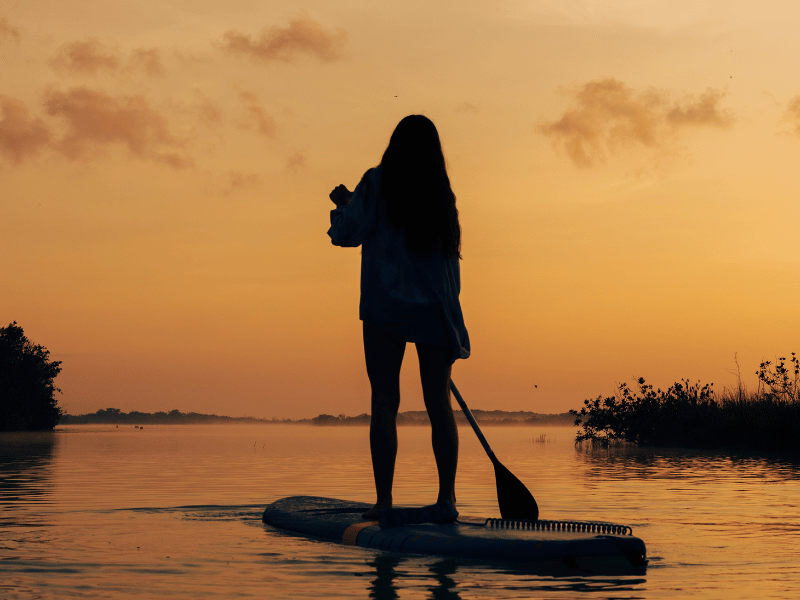
Los canales de manglares orientales de la laguna ofrecen pasadizos íntimos donde las raíces forman arcos naturales y los peces pequeños se mueven por debajo de la tabla. Las garzas, las garcetas y los cormoranes son comunes. Los cocodrilos pequeños toman el sol en las orillas y se meten en el agua a medida que te acercas.
Vaya antes de las 10 a.m. Después, el calor y el viento se intensifican rápidamente y los canales pierden su quietud. Los sistemas de manglares filtran la laguna y evitan la erosión. Remar por ellos lentamente es una de las mejores maneras de entender qué es lo que hace que el ecosistema de Bacalar funcione.
5. Canal de los Piratas (Canal de los Piratas)
El Canal de los Piratas conecta la laguna con el Caribe a través de una estrecha vía fluvial documentada en los registros coloniales españoles del siglo XVII como una ruta de ataque hacia el interior. En la actualidad, es una de las secciones más profundas de la laguna y crea la coloración azul más intensa de cualquier parte del sistema de agua dulce.
Acceso en kayak o paseo en barco. La corriente puede ser más fuerte de lo que parece; mantente cerca de zonas poco profundas si no eres un nadador seguro en aguas abiertas. La temperatura media del agua durante todo el año es de 26 °C (78 °F).
6. Clubes de playa en la laguna
Varios clubes de playa bordean la carretera de la laguna al sur de la ciudad de Bacalar y ofrecen acceso al muelle, hamacas colgadas sobre el agua, comida y bebidas. Esta es la versión más social y relajada de la experiencia en la laguna: menos deportiva que andar en kayak, más bien flotar y observar cómo cambian los tonos de azul durante la tarde. Busca lugares más pequeños gestionados localmente en lugar de grandes operaciones comerciales.
Cenotes y maravillas naturales cerca de Bacalar
7. Cenote Azul: El clásico
El Cenote Azul se encuentra a las afueras de la ciudad de Bacalar, un enorme cenote al aire libre con agua que alcanza una profundidad de 90 metros. El color azul proviene del contenido mineral y de la refracción de la luz a través de la piedra caliza. Es el cenote más visitado de la zona, lo que significa que el momento es importante: vaya de lunes a viernes por la mañana o al final de la tarde.
Instalaciones: Restaurante, vestuarios, chalecos salvavidas (obligatorios en las secciones profundas), plataformas para saltar acantilados.
Precio de entrada: Aproximadamente entre 50 y 100 pesos (entre 3 y 6 USD).
A diferencia de los cenotes de cuevas que se encuentran en otras partes de la península de Yucatán, el Cenote Azul está completamente abierto al cielo. El agua se mantiene más fría que la de la laguna (alrededor de 23 a 24 °C), lo que hace que la humedad de Bacalar sea notablemente refrescante.
8. Cenote Cocalitos: estromatolitos vivos de cerca
El cenote Cocalitos se conecta con la laguna sur y vale la pena visitarlo específicamente para ver estromatolitos. Estas formaciones texturizadas y poco profundas son visibles desde la orilla del agua. Puedes nadar cerca de ellas, pero tocarlas daña estructuras que tardaron milenios en formarse.
Pautas de conservación:
- Solo protector solar seguro para arrecifes
- No ponerse de pie ni tocar los estromatolitos
- No hay dispositivos de flotación que puedan arrastrar o chocar contra las formaciones
Precio de entrada: Aproximadamente entre 50 y 100 pesos (entre 3 y 6 USD). Los estromatolitos se fotografían bien a la luz de la tarde.
🟡 Pautas de conservación:
- Solo protector solar apto para arrecifes (los protectores solares químicos dañan las comunidades microbianas)
- No se pare ni toque los estromatolitos
- Sin dispositivos de flotación que puedan arrastrarse o chocar
9. Cenote Negro y cenotes ocultos
Entre Bacalar y Chetumal hay varios cenotes menos conocidos: el Cenote Negro, el Cenote Esmeralda y otros que no aparecen en los principales mapas de viajes. Requieren transporte y, a veces, caminar por senderos no señalizados. Las tarifas de entrada van directamente a las familias locales que mantienen el acceso.
Algunos cenotes se encuentran en tierras ejidales (comunales) o las comunidades mayas locales los consideran sagrados. Si la señalización restringe el acceso o la población local desalienta la entrada, respete esos límites.
Experiencias culturales e históricas
10. Fuerte de San Felipe
Este fuerte español del siglo XVIII domina la laguna desde el punto más alto de Bacalar, construido para defenderse de los mismos piratas por cuyo canal se navega en kayak. En la actualidad alberga un pequeño museo que abarca la historia de Bacalar, desde el asentamiento maya, pasando por la Guerra de Castas, hasta la actualidad.
Detalles de la visita: Abierto de martes a domingo, de 9 a.m. a 5 p.m. La entrada cuesta aproximadamente 75 pesos (4 USD). Planifica entre 45 y 60 minutos. Las murallas ofrecen la mejor vista aérea de los gradientes de color de la laguna; vale la pena verlas al menos una vez desde arriba, en lugar de hacerlo desde el nivel del agua.
11. Centro de la ciudad de Bacalar
La designación Pueblo Mágico de Bacalar reconoce su laguna preservada, sus coloridas calles y su cultura viva de influencia maya. Las calles que salen de la plaza principal albergan tiendas locales que venden hamacas tejidas a mano y madera tallada, pequeños mercados donde los residentes compran productos, arte callejero que incorpora la iconografía maya y taquerías que se llenan de familias después de las 2 de la tarde.
El inglés es limitado fuera de los hoteles y los principales operadores turísticos. El español básico va más lejos aquí que en cualquier otro lugar de la Riviera Maya. La ciudad funciona a su propio ritmo: las tiendas cierran por las siestas vespertinas, la vida transcurre a su propio ritmo, y ese ritmo no es un inconveniente. Ese es el punto.
12. Herencia maya: presente, no pasado
El nombre de Bacalar proviene del idioma maya. Bak Halal se traduce aproximadamente como «rodeado de juncos». La evidencia arqueológica documenta una ocupación continua aquí durante más de 2.000 años. Muchos residentes de Bacalar tienen herencia maya; algunos hablan lenguas mayas en casa.
Busque iniciativas dirigidas por la comunidad en lugar de ceremonias performativas. Varias cooperativas locales ofrecen clases de cocina, talleres de artesanía e intercambios culturales donde las ganancias se quedan en la comunidad. Pide permiso antes de fotografiar personas. No te refieras a la cultura maya en tiempo pasado, es presente.
🔵 Enlace interno: Viajar respetuosamente en Bacalar → [enlace]
13. Ruinas mayas cerca de Bacalar
Kohunlich (65 km al oeste) cuenta con el Templo de las Máscaras con grandes caras de estuco. Dzibanché (80 km al oeste) tiene pirámides a las que aún puedes subir, con una fracción de los visitantes que encontrarías en Tulum o Chichén Itzá. Ambas requieren un automóvil y aproximadamente una hora en automóvil. Lleve agua y repelente de insectos; la sombra es mínima.
Aventuras culinarias en Bacalar
Qué comer en Bacalar
Busca:
- Pescado fresco: robalo (róbalo), mojarra y lubina preparados a la plancha, al mojo de ajo o tikin xic (marinado con achiote y asado en hojas de plátano)
- Especialidades yucatecas: cochinita pibil, panuchos, salbutes
- Productos locales: chaya, chiles xácticos, epazote, chicozapote, mamey
- Tacos de lugares adyacentes al mercado en el centro de la ciudad
El Sr. Taco es una institución local. La Playita es una palapa frente al mar en la que se puede pescar pescado fresco y disfrutar de vistas al muelle. Waah Cocina de Origen sirve cocina tradicional yucateca sin pretensiones. La Cabanita Grill & Cantina es una fonda dirigida por mujeres con porciones generosas.
Flora en Boca de Agua
Flora trabaja con ingredientes yucatecos de temporada interpretados a través de una técnica contemporánea. El menú del chef Carlos Bordonave cambia en función de lo que aportan los productores locales cada semana: relaciones directas con las granjas y los pescadores cercanos, en lugar de con las cadenas de suministro mayoristas. El entorno está abierto a la jungla y la laguna.
🟡Flora at Boca de Agua is one of the few restaurants in the region where the kitchen's sourcing decisions are as considered as its cooking. Worth booking in advance.
Explore Flora's approach to Yucatecan cuisine.
Other recommendations:
- La Cabanita Grill & Cantina - casual, women-run fonda with generous portions
- La Playita - waterfront palapa, fresh catches
- Waah Cocina de Origen - traditional Yucatecan cocina
Places with picture menus in four languages often signal tourist-focused spots with less attention to quality.
Regional Drinks
More interesting than mezcal (which isn't cultivated in Yucatán) is xtabentún — a regional liqueur made from fermented honey and anise, produced on the Yucatán Peninsula for centuries. Craft cocktails incorporating chaya, hibiscus, and tropical fruit appear on menus throughout Bacalar.
Cooking Classes
Several operators offer market tours followed by hands-on cooking. Cocina Micelio is consistently recommended. These classes run 3–4 hours and cost approximately 800–1,500 pesos ($40–75 USD). Choose classes run by local families — your pesos stay in the community.
Recommended: Cocina Micelio
Wellness and Slow Travel
14. Yoga and Outdoor Practice
Several studios in Bacalar offer classes on platforms overlooking the lagoon, in jungle clearings, or on rooftops. Drop-in classes cost 150–300 pesos ($8–15 USD). Some properties offer complimentary sessions for guests — ask the team at Boca de Agua for current scheduling.
The setting does a lot of the work. Practicing on a platform over the lagoon at 6:30 AM, with the water still and the birds beginning, is a different experience from a studio class. The context is the practice.
15. Spa Treatments in the Jungle
Several properties offer massage and spa services in open settings — treatment rooms with walls open to jungle, platforms overlooking the lagoon. A 90-minute massage typically costs 1,200–2,000 pesos ($60–100 USD). Quality varies; ask your hotel for specific recommendations or read recent reviews.
Some spas incorporate Maya-influenced approaches — temazcal (sweat lodge) ceremonies, herbal compresses, copal smoke. Ask who conducts ceremonies and what their background involves. Legitimate temazcal leaders train for years and approach the practice as sacred, not aesthetic.
16. The Art of Doing Nothing
Hammock culture is not a cliché in Bacalar — it's the appropriate response to the afternoon heat and the pace of the place. Dock hammocks, hammocks strung between trees over the water, palapa hammocks facing the lagoon. The ritual is: launch the kayak at dawn, eat well at midday, find a hammock by 2 PM, return to the water by 5.
Spotty Wi-Fi and slow cell data outside town help this rhythm along. After two or three days, that stops feeling like a limitation.
🟡 Slow travel note: The travelers who get the most out of Bacalar are the ones who stop trying to fill it. Build your days loosely. Leave room for the lagoon to change color twice.
Best Time of Day for Activities in Bacalar
- Dawn (5:30–7:00 AM): Kayak or paddleboard before other boats launch. The lagoon is yours.
- Morning (7:00–11:00 AM): Breakfast, a cenote visit, a boat tour. The light is good and the heat is manageable.
- Midday (12:00–4:00 PM): Retreat from the sun. Read in a hammock. Swim when you feel like it. Nap. The midday hours in Bacalar are not wasted — they're the rhythm of the place.
- Late afternoon (4:00–6:00 PM): Bike into town for the market. Visit a cenote as crowds thin. The light softens and temperatures drop.
- Sunset (6:30–7:30 PM): Find a dock. Watch the colors change across the lagoon. Nothing else is required.
Architecture and Design Worth Seeing
Frida Escobedo's Vision
Mexican architect Frida Escobedo, known internationally for her Serpentine Pavilion in London — designed Boca de Agua's 22 villas and treehouses as elevated structures on pilotes that don't touch the ground. Root systems and ground-level ecology stay intact. More than 90% of the 82-acre property remains unbuilt.
The materials are specific: FSC-certified chicozapote wood from managed felling programs, furniture built by local artisans from recycled materials. Recognized by TIME's World's Greatest Places 2024 and Nat Geo Traveller UK — not for aesthetics alone, but for demonstrating that design and conservation can be the same decision.
🟡 Design spotlight: The treehouse architecture trend in Bacalar isn't decorative — it's structural. Elevating buildings on pilotes means root systems and ground ecology stay intact. It's a different starting question: not "how do we build here" but "how do we build without touching here."
Explore Boca de Agua's architectural philosophy.
Bacalar's Emerging Design Circuit
Beyond individual properties, Bacalar is becoming a destination for architecture tourism—people visit buildings the way they visit museums.
- Boca de Agua: Frida Escobedo's treehouse structures with 90% jungle preservation
- Naya Bacalar: Sustainable boutique hotel using local materials, cross‑ventilation, and shading instead of conventional air conditioning to keep interiors cool
- Ecoparque Bacalar boardwalk by Colectivo C733: Open-air timber walkway and pavilions over the lagoon, shortlisted for a Dezeen Award and published internationally for its low-impact design.
What to Look For in Sustainable Architecture
When choosing where to stay in Bacalar, look for:
- Structures on stilts or piers that don't seal ground
- Solar panels and rainwater collection systems
- Natural ventilation replacing air conditioning
- Local materials used in traditional ways
- Preserved jungle canopy and sight lines
- Native landscaping instead of imported ornamentals
Use this checklist when choosing where to stay; supporting regenerative architecture with your booking.
These spaces not only directly shapeBacalar's development trajectory, they’re also rewarding to photograph—textures, shadows, framed lagoon views create striking compositions.
Day Trips from Bacalar
Mahahual: Caribbean Beach Town
Mahahual sits on the Caribbean coast 90 minutes east — saltwater, coral reefs, and a small fishing village with a malecon lined with restaurants and dive shops. A different ecosystem from the lagoon: reef snorkeling replaces stromatolite kayaking, ocean replaces freshwater.
Distance: ~70 km, 1.5 hours by car. Check cruise ship schedules before going — the town is small enough that a single ship's passengers change its character entirely.
Chetumal: Maya Museum and Shopping
Chetumal, capital of Quintana Roo, is 40 minutes south. Most travelers skip it, but the Museum of Maya Culture is worth 2–3 hours. Better banking, medical services, and market provisions than Bacalar. The Boulevard Bahía waterfront has restaurants with bay views.
Distance: ~40 km, 40 minutes by car.
Kohunlich and Dzibanché: Mayan Ruins Without the Crowds
Kohunlich features the Temple of Masks with large stucco faces. Dzibanché has pyramids you can still climb — unlike Tulum or Chichen Itzá, where climbing is restricted. You might have entire complexes to yourself. Bring water, insect repellent, and sun protection; shade is minimal.
Distance: Kohunlich ~65 km (1 hour); Dzibanché ~80 km (1.5 hours). Both require a car.
Where to Stay in Bacalar
Where you stay shapes your entire Bacalar experience. The difference between lagoon-front and town-center, between a hotel that extracts from the ecosystem and one that actively restores it, fundamentally changes what you return home having done.
Lagoon vs. Town vs. Jungle
Lagoon locations offer direct water access and sunrise views. You wake to birds and light on water. You'll need bikes or a car for restaurants and shopping.
Town center locations put you near food, artisan shops, and local rhythm. You'll need to travel for swimming and cenotes.
Jungle properties offer privacy and immersion in natural surroundings — furthest from both lagoon and town conveniences, closest to the ecosystem itself.
Recommended Properties
Luxury / Design-Forward ($150–300+ USD/night):
- Boca de Agua: Treehouse architecture by Frida Escobedo, 90% jungle preservation, Flora restaurant, private lagoon access, 100% renewable energy via Ammper, an MBR water treatment system that prevents effluent from reaching the lagoon, and the on-site NGO Con Mono Araña. Explore our treehouses.
- Our Habitas Bacalar: A holistic lagoonfront retreat with A-frame cabanas, low-impact modular design, and wellness programming rooted in local culture.
Mid-Range ($80–150 USD/night):
- Eco-hotel Casa Lamat: Lagoonfront eco-lodge with solar power, permaculture gardens, and sunrise yoga on a hammock-lined dock.
- Azul Nombre olvides: Cabañas con estructura en forma de A en la laguna construidas con materiales locales y administradas con un enfoque centrado en la conservación.
Preocupado por el presupuesto (entre 30 y 80 USD/noche):
- La casa de Yak Lake: Albergue social frente a la laguna con un muelle para nadar y una gestión ecológica del agua, la energía y los residuos.
- Ecocamping Yaxché: Campamento ecológico rústico con hamacas sobre el agua y una experiencia inmersiva en la naturaleza.
Descubre los mejores hoteles en Bacalar
Planificación práctica: Bacalar de un vistazo
¿Vale la pena visitar Bacalar?
Sí, si valoras la belleza natural, el diseño y los espacios con poca gente por encima de la vida nocturna y la comodidad del resort. El ecosistema de la laguna es realmente raro. También lo es el ritmo de la ciudad.
¿Cuántos días necesitas en Bacalar?
Mínimo 2 noches para ver lo más destacado. Lo ideal son entre 4 y 5 noches para disfrutar de la laguna en diferentes momentos del día y relajarse lo suficiente como para sentir la diferencia.
¿Se puede nadar en la laguna de Bacalar?
Sí. Agua dulce, segura durante todo el año, con un promedio de 26 °C (78 °F). Evite nadar cerca de los canales para botes.
¿Hay un río lento en Bacalar?
Sí, Los Rápidos, una corriente natural que crea una suave deriva a través de la laguna. Los vendedores locales alquilan anillos salvavidas en las cercanías.
¿Se puede bucear en Bacalar?
La laguna es más adecuada para practicar kayak y nadar sobre estromatolitos que para bucear en los arrecifes. Para bucear en los arrecifes, excursión de un día a Mahahual.
¿Bacalar es seguro?
Sí. Bacalar tiene tasas de criminalidad bajas en comparación con los destinos turísticos más grandes de Quintana Roo. Se aplican las precauciones estándar: no deje objetos de valor desatendidos, evite caminar solo a altas horas de la noche en áreas aisladas.
Cómo llegar aquí
- Desde Cancún: 310—340 km, ~4,5—5 horas en coche o autobús ADO
- Desde Tulum: 215—230 km, ~2,5—3 horas
- Desde Chetumal: 40 km, ~40 minutos
Cómo moverse
- Bicicleta: terreno plano, alquileres de 100 a 200 MXN/día. Suficiente para la ciudad y la carretera de la laguna.
- Coche: Útil para ir a cenotes y excursiones de un día. Alquileres de 400 a 800 MXN/día.
- Colectivo: camionetas compartidas a Chetumal y pueblos cercanos. 30-60 MXN.
- Autobús ADO: confiable desde Cancún, Tulum y Chetumal. Reserve con antelación durante la temporada alta.
Turismo regenerativo en Bacalar
El turismo sostenible minimiza los daños. El turismo regenerativo va más allá: mejora activamente los lugares que toca.
El enfoque de Boca de Agua es específico: 1 hectárea de manglar replantada en un área previamente dañada; un sistema de biorreactor de membrana (MBR) que evita que cualquier efluente llegue a la laguna; muebles fabricados por artesanos locales con materiales reciclados; energía obtenida al 100% de Ammper, un proveedor mexicano de energía renovable; y apoyo a la ONG Con Mono Araña, que estudia y protege la población de monos araña en la reserva de la propiedad.
No se trata de afirmaciones vagas. Son sistemas medibles y compromisos a largo plazo.
Cuando eliges operadores y alojamientos comprometidos con el turismo regenerativo, tu visita contribuye a la salud de Bacalar a largo plazo.
Recursos adicionales:
Principios del turismo regenerativo - Futouris
Coalición para la Conservación de Bacalar
🟡 Busque compromisos específicos y verificables en lugar de mensajes genéricos «ecológicos». Pregunte a las propiedades: ¿Qué porcentaje del personal es local? ¿De dónde provienen los alimentos? ¿Qué proyectos de conservación apoyas? ¿Cómo se gestionan el agua y los residuos?
Planifica tu visita a Bacalar
Bacalar ofrece algo cada vez más raro: un destino que premia la presencia por encima de la productividad. Las mejores experiencias aquí (paseos en kayak al amanecer, comidas lentas, arquitectura cuidada y respeto cultural) requieren paciencia más que planificación.
Quédate más tiempo del que consideres necesario. Elija operadores que den más de lo que reciben. Deja que el ritmo de la laguna se convierta en el tuyo.